AI and automation are driving 2027 comms budgets
Flat budgets belie an undercurrent of growth and opportunity.



Mike Prokopeak is Ragan Communications director of Communications Leadership Council learning, community and content.
Flat is the new up when it comes to planning your communications budget.
That’s the takeaway from a pulse survey of 30 senior communications leaders conducted by Ragan’s Communications Leadership Council. But that headline masks important activity worth watching as companies begin 2027 planning.
Budgets may not be growing but the work is expanding.
Flat budgets, targeted bets
A majority (64%) of communicators surveyed said they expect their 2027 comms budget to stay about the same or to see a slight decrease. The reasons will surprise few. A volatile geopolitical environment, rising interest rates and ballooning costs due to tariffs and supply chain pressures top the list.
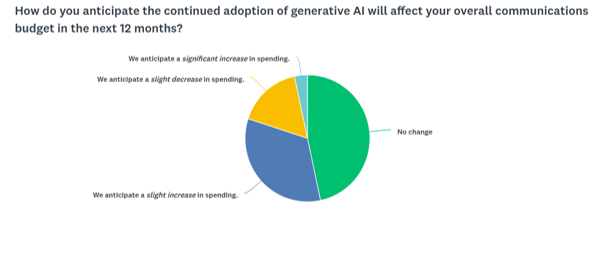
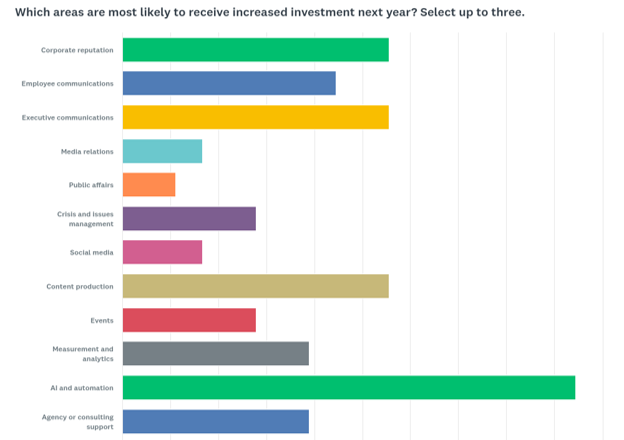
At the same time, stock markets have remained resilient, largely due to a flood of investment in AI and technology. That dynamic is also apparent in communications budgets: restrained discretionary spending with targeted investments in AI and automation.
Of the third (36%) of communicators who expect their budget to increase, most are expecting just a slight increase in spending. AI and automation investment is what’s driving that spending.
The proof problem
But that investment comes with a catch. Leaders expect proof it’s paying off. Analysis of recent data suggests many comms teams aren’t ready to provide it.
In a October call hosted by Ragan’s Center for AI Strategy, center leaders presented a summary of the results from the more than 200 communicators who have completed the AI Readiness Assessment. While most are moving beyond experimentation with AI, only 22% can successfully show a documented improvement or return on investment.
Measurement received the lowest score of the eight areas of AI adoption, and more than half (53%) reported they have not defined any AI metrics they are tracking. That gap could prove costly in 2027 planning.
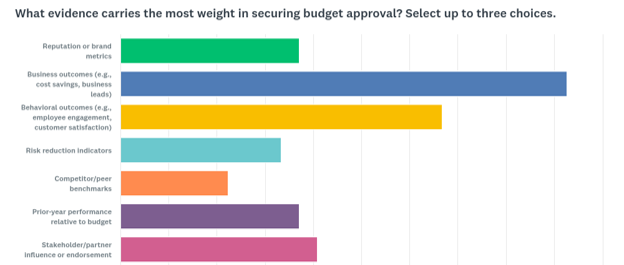
As the survey of communications leaders showed, business outcomes such as cost savings or positive revenue indicators are the evidence most important in getting communications budget approval.
Measure capacity, not cost
Cost savings may be what wins approval, but the most successful teams don’t pitch AI as a way to cut costs. That’s a framing that can turn into a conversation about headcount. Instead, they frame AI as capacity building: hours freed and speed gained, translated into business value.
Automating preparation work for employee Q&A sessions with leaders saved more than 30 hours of manual work per month at one of the companies featured in a special report from Ragan’s Communications Leadership Council.
Another uses AI-generated audience profiles to test messages in minutes, effectively streamlining work that once took weeks. A third featured company uses AI to analyze how town hall messages land across a global enterprise, a time-consuming job that once meant marking up transcripts by hand.
Speed also changes what teams can act on. One company featured in the report uses a monthly reputation scorecard to spot dips and re-push relevant stories quickly in response.
Putting it into your 2027 plan
Translate this to budget planning by measuring the baseline of a workflow’s hours or costs before automating it, then report the time recovered and demonstrate where those savings were reinvested.
Don’t leave budget planning up to chance. A flat budget environment is still ripe for potential opportunities for growth.
Flat may be the new up, but the work is still expanding. The communicators who can show exactly how AI expands their capacity will be the ones whose budgets grow with it.